Top Cities to Teach English in South America
Date: 16 January 2026
Read Time: 12 minutes
Why teach English in South America in 2026?
South America in 2026 offers a powerful mix of rising English language demand, lower entry barriers than some Asian or Middle Eastern markets, and a vibrant lifestyle for first‑time and experienced teachers alike. Many countries in the region accept teachers without a four‑year degree, provided they hold a recognised TEFL certification, which makes it attractive for career changers and recent graduates.
Cities such as Buenos Aires, Santiago, Bogotá, Lima and Quito are expanding bilingual education and corporate language training, pushing up demand for qualified English teachers. For teachers who want strong job prospects, affordable living and rich cultural immersion, South America is a compelling choice for 2026 and beyond.
Top cities to teach English in South America
While there are opportunities across the continent, several urban hubs stand out in 2026 for salary potential, job volume and lifestyle: Buenos Aires (Argentina), Santiago (Chile), Bogotá (Colombia), Lima (Peru) and Quito (Ecuador). These cities combine established language school networks, growing international schools and a strong private tutoring market.
In each of these destinations, teachers can access a mix of classroom roles and private clients, topping up income with business English or exam preparation classes. The sections below outline what to expect in each city, with a salary and demand overview in the table further down the page.
Buenos Aires, Argentina
Buenos Aires is Argentina’s main English‑teaching hub, with the majority of jobs concentrated in language institutes, private schools and international schools across the city. Typical monthly earnings for teachers across Argentina range from about 600–1,200 USD, with higher salaries at international schools and for experienced teachers.
The city offers a European‑style café culture, strong arts scene and an active expat community, which makes settling in relatively straightforward. Living costs for a single person are commonly estimated between 800 and 1,200 USD a month, depending on rent and lifestyle, so your income can comfortably cover core expenses and some travel from better‑paid posts.
Santiago, Chile
Santiago leads Chile’s TEFL market, hosting most of the country’s private and international schools as well as well‑paid business English contracts. Public school salaries may start from roughly 680–1,020 USD per month, but private schools can offer around 910–1,700 USD and international schools may reach 1,700–2,850 USD monthly.
Language institutes in Santiago typically pay about 570–1,140 USD per month, with teachers often supplementing income via private tutoring at 11–28 USD an hour. Combined with moderate regional living costs, this makes Santiago one of the stronger choices in South America for teachers who want a balance of income and quality of life.
Bogotá, Colombia
Bogotá is Colombia’s capital and main economic centre, with a high concentration of universities, bilingual schools and corporate clients needing English training. Teachers can find roles in language institutes, K–12 schools and corporate classrooms, with wages broadly competitive for the region and often supplemented by private tutoring.
Cost of living estimates suggest that a single person’s monthly expenses in Bogotá (excluding rent) are generally lower than in Buenos Aires, and total living costs are around 14% cheaper overall. Many teachers improve their financial position by combining salaried work with private lessons and, in some cases, online teaching.

Lima, Peru
Lima is Peru’s largest city and a growing TEFL destination, with demand from private schools, language centres and an expanding tourism and business sector. While salaries in Peru tend to sit slightly below those in Argentina or Chile, the lower cost of living helps teachers enjoy a comfortable lifestyle.
Most positions in Lima are found in private language schools and institutes, often paying hourly wages that can be increased with extra classes and exam preparation work. Teachers who speak some Spanish and hold a strong TEFL qualification can sometimes progress into better‑paid roles at bilingual or international schools.
Quito, Ecuador
Quito offers a smaller, more manageable city experience than some regional capitals, but still has solid demand for English teachers in private language schools and NGOs. A standard 120‑hour TEFL certificate is usually enough to access many entry‑level roles, with some higher‑tier schools preferring teachers who hold degrees or Level 5‑equivalent qualifications.
Cost of living index data for the region positions Quito in the mid‑range for South American cities, below Buenos Aires and Santiago but above some smaller cities. For teachers who prioritise Andean landscapes and outdoor lifestyle as much as salary, Quito can be an appealing base.
Average TEFL salaries & demand by city
The table below brings together typical salary ranges by institution type for major South American TEFL cities in 2026, plus a general indication of teacher demand.
| City | Institution Type | Typical Monthly Salary (USD) | Demand Level (2026) |
|---|---|---|---|
| Buenos Aires, Argentina | Public schools | Approx. 330–690 | Moderate–High (peak in March & July intakes) |
| Buenos Aires, Argentina | Private schools | Approx. 500–1,100 | High in bilingual and international schools |
| Buenos Aires, Argentina | Language schools | Approx. 360–830 | High, especially for adults and business English |
| Buenos Aires, Argentina | International schools | Approx. 1,100–1,920 | More competitive; prefer experience. |
| Santiago, Chile | Public schools | Approx. 680–1,020 | Steady demand via national programmes and local hiring |
| Santiago, Chile | Private schools | Approx. 910–1,700 | High, particularly in bilingual schools |
| Santiago, Chile | Language schools | Approx. 570–1,140 | Very high, including corporate contracts |
| Santiago, Chile | International schools | Approx. 1,700–2,850 | Competitive but strong packages for qualified teachers |
| Bogotá, Colombia | Language schools | Approx. 600–1,000 (typical range) | High, especially for adults and exam prep |
| Bogotá, Colombia | Schools & universities | Approx. 800–1,500 (varies by institution) | Growing demand in bilingual education |
| Lima, Peru | Language schools | Approx. 500–900 (typical range) | High around term starts and business peaks |
| Lima, Peru | Private schools | Approx. 700–1,300 (typical range) | Moderate–High in bilingual & international schools |
| Quito, Ecuador | Language schools | Approx. 500–800 (typical range) | Steady demand, especially in private institutes |
| Quito, Ecuador | Schools & NGOs | Stipend‑level to 900+ USD depending on post | Moderate, with seasonal peaks |
These salary bands are indicative and vary by qualifications, experience, teaching hours and whether housing or bonuses are included in your contract. Many teachers also increase overall earnings by offering online lessons to students in other time zones alongside their in‑country roles.
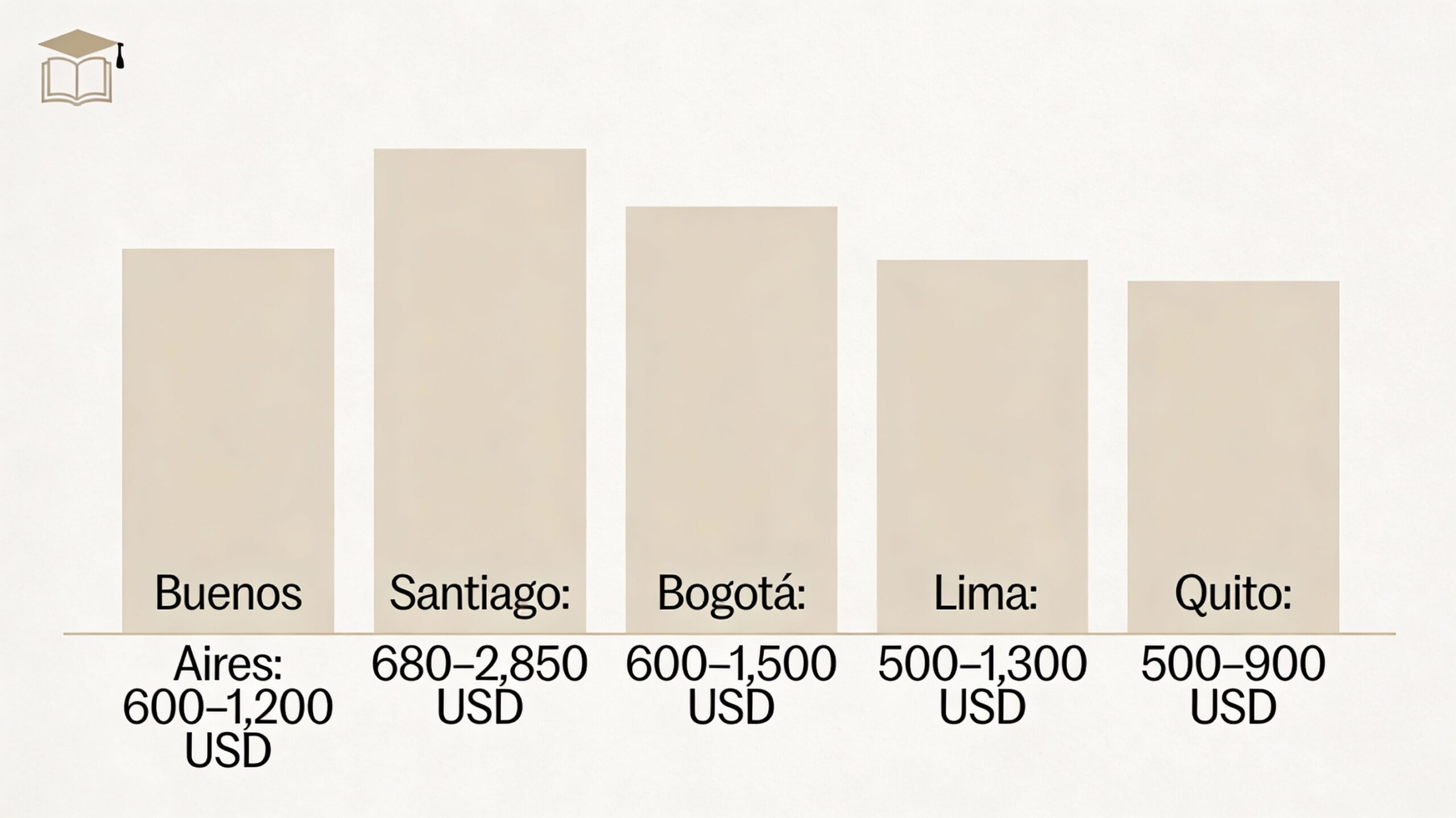
Living costs in key South American cities
Cost of living across South America sits below that of Western Europe and North America, but there is meaningful variation between cities. For example, comparison data suggests that overall costs in Bogotá are around 14% lower than in Buenos Aires, mainly due to cheaper rent and food.
Monthly estimates for a single person in Buenos Aires are often placed between 800–1,200 USD excluding flights and major extras, with similar or slightly lower budgets in Bogotá and Lima. Santiago is typically a little more expensive than many other South American cities, while Quito sits in the middle of regional cost‑of‑living rankings.
Visa requirements for Europeans and US citizens
Visa rules change regularly, but most South American countries require a work visa or residence permit if you plan to teach English legally for longer than a short tourist stay. Many schools help sponsor work visas once you have a job offer, particularly in Argentina, Chile and Colombia.
Argentina (Buenos Aires)
To work as an international teacher in Argentina, you usually need a work visa sponsored by your employer. Typical steps include securing a job offer, providing a valid passport, signed contract, proof of qualifications, police clearance and medical certificate, after which your employer submits documents to the National Immigration Directorate.
Work visas are commonly granted for about one year and can be renewed, with processing started either via an Argentine consulate abroad or, in some cases, in‑country. European and US teachers should always check the latest requirements with official Argentine government sources before applying.
Chile (Santiago)
Teachers in Chile usually enter on a work visa or specific temporary residence status linked to employment, obtained via the Chilean immigration authorities or consulates abroad. For government‑linked programmes such as the English Open Doors Programme, successful applicants receive structured guidance on visa paperwork and placement locations.
Application steps typically include an employment offer or programme acceptance letter, criminal background check, proof of qualifications and passport validity for at least six months beyond arrival. Visa processing is handled online or via consulates, and teachers are generally required to register with local authorities shortly after arrival.
Colombia (Bogotá)
Teachers in Colombia often apply for an M‑category work visa, either from their home country or in Bogotá at the Ministerio de Relaciones Exteriores. Applicants usually need a job offer, degree or TEFL certification, passport, completed application and fee payment; once granted, they must obtain a national identity card (cédula) within a set timeframe after arrival.
European and US citizens can often enter visa‑free for short stays as tourists, but working legally requires a work visa connected to an employer or programme. Using recognised programmes or reputable schools increases the likelihood of smooth processing.
Peru and Ecuador (Lima & Quito)
In Peru and Ecuador, teachers who intend to stay beyond short‑term volunteering generally need a work visa or residence permit backed by a school or language centre. Requirements commonly include a job offer, criminal background check, proof of qualifications and consular processing or in‑country registration.
Because procedures and permitted nationalities can change, European and US teachers should always consult official embassy or consular websites before making travel plans. Many reputable TEFL providers and schools offer guidance on documentation and timeline expectations for these destinations.
Government programmes for English teachers
Several South American countries run or support government‑linked initiatives to bring native or near‑native English speakers into public schools. These programmes often provide structured placements, orientation and, in some cases, stipends or housing support.
Chile’s English Open Doors Programme (EODP), run by the Chilean Ministry of Education in partnership with the UN Development Programme, recruits foreign teachers to assist in public schools across the country. In Colombia, initiatives such as the Teach English in Colombia projects and SENA National Training Service schemes offer volunteering or stipended teaching opportunities aimed at improving English proficiency nationwide.
Best TEFL courses & is a degree required?
For most entry‑level teaching jobs in South America, a 120‑hour accredited TEFL course is considered the minimum standard, with Level 5 courses increasingly preferred by higher‑paid schools. Premier TEFL’s accredited 120 Hour TEFL Course and advanced 240 Hour TEFL Course are designed to meet these requirements and are recognised by employers across the region.
A four‑year degree is not always mandatory in South America; many countries actively welcome non‑degree teachers who hold a recognised TEFL certificate, particularly for language institute roles. However, international schools and some government or university positions often reserve posts for degree‑qualified teachers, so choosing a higher‑level TEFL course can improve access to these roles.
Useful internal resources to support your planning include:
School terms & the best time to apply
Most South American school systems follow a calendar that runs broadly from late February or March through to November or December, with variations by country. As a result, peak hiring for public and private schools usually happens in the months leading up to the new academic year and mid‑year intakes.
For Argentina, Chile and much of the Southern Cone, applying between October and January positions you well for March start dates, while mid‑year recruitment peaks around June–July. Language schools recruit year‑round but often intensify hiring before major business seasons and exam periods, so applying a couple of months in advance is sensible.

Is it easy to find a job & where to search?
For qualified TEFL teachers, it is generally considered achievable to secure a job in South America, especially in large cities and at language institutes. Competition can be stronger for better‑paid international schools and government‑linked roles, where experience and higher‑level qualifications give you an advantage.
Useful job‑hunting strategies include:
-
- Using reputable TEFL job boards and teach‑abroad portals that specialise in Latin America.
-
- Applying directly to schools listed in guides such as Premier TEFL’s South America resources and destination pages.
-
- Combining online applications with on‑the‑ground visits during peak hiring windows in major cities.
External sites such as GoOverseas’ South America teaching section provide additional job listings and reviews, which are useful when cross‑checking offers.
Types of schools & top TEFL certifications
Across South America, English teachers work in several key institution types: public schools, private and bilingual schools, international schools, language institutes and universities or corporate training providers. Each offers a different balance of salary, hours, benefits and student age group, which is why choosing the right TEFL certification matters.
For general language school and entry‑level positions, a solid 120‑hour accredited TEFL certificate is usually sufficient. Teachers who want to work in international schools or specialise in areas such as Business English or exam preparation often benefit from Level 5 courses or combined course packages that include teaching practice and specialist modules.
How TEFL Explorer helps you plan your move
Key benefits include an AI lesson‑planning generator, instant activity creation, personalised feedback templates and real‑time job‑market intelligence that highlights salary ranges, teacher demand and visa pathways. Using TEFL Explorer alongside Premier TEFL’s South America guides helps streamline the journey from certification to classroom, saving planning time and reducing uncertainty about next steps.
You can learn more about TEFL Explorer and its benefits here: TEFL Explorer – AI‑Powered TEFL Education.
FAQs
Do I need a degree to teach English in South America?
A degree is not mandatory for all South American teaching jobs; many language schools and institutes hire teachers who hold a recognised TEFL certificate but no four‑year degree. That said, degrees are commonly required for international schools, universities and some government‑linked programmes, so having one opens more doors.
Which TEFL course is best for South America?
A fully accredited 120‑hour TEFL course is the minimum recommended option for most South American roles. Teachers who want higher‑paid jobs or long‑term careers often choose a Level 5 or combined 240‑hour course from Premier TEFL for stronger recognition.
When is the best time to apply?
The best time to apply for school‑based roles is usually between October and January for March starts, and again mid‑year around June–July. Language schools hire throughout the year but increase recruitment before busy seasons and exam periods.
Is it easy to get a work visa?
With a confirmed job offer and the right documentation, many teachers successfully obtain work visas for countries such as Argentina, Chile and Colombia, though processes can take time. Working with reputable schools or programmes greatly helps in navigating requirements and ensuring legal status.
Can I save money teaching in South America?
Savings potential varies by city and lifestyle, but teachers in cities such as Santiago and Buenos Aires can often save from international or better‑paid private roles. In lower‑cost cities like Bogotá and Lima, combining salaried work with private tutoring or online teaching increases your capacity to save.
The post Top Cities to Teach English in South America 2026 appeared first on Premier TEFL.